Showing posts with label curiosities. Show all posts

Saturday, 3 December 2016

Alphabet shuffle


Take a look to this channel! it has a lot of fun and instructional videos, you can learn a lot! but you also need to know a little bit of English... https://goo.gl/T08Esh
Hope you like it!

Sunday, 16 October 2016

Plot twist the classical stories!


MR WOLF'S PANCAKES


PRINCE CINDERS


JIM AND THE BEANSTALK


THE THREE LITTLE WOLVES AND THE BIG BAD PIG


Wednesday, 15 June 2016

More exciting and interesting Apps for the classroom!

Today I introduce you SOCRATIVE. 

This tool can help you to participate and cooperate in your classroom. It goes one step further than the other apps I showed in the blog, Socrative has got quizzes, quick questions,... and everything organised to avoid argues!

But...an image is worth a thousand words


Tuesday, 14 June 2016

Why is this blog called CatchUp?...

First of all, it is a play on words between the words "Ketchup" and the phrasal verb "Catch up"
 A joke told in one of my favourite movies, Pulp Fiction (NOT FOR YOU, KIDS!!), gave me the idea.


But I don't get it! what's the meaning of Catch Up??

It has several translations, but I'll take just two of them, one to understand the joke, and the other  to get the meaning of the blog's name. Try to guess....


Monday, 23 May 2016

LA RAE CONTRA LOS ANGLICISMOS

¡Hello everyone!

Hoy me he topado con un interesante vídeo de la RAE (Real Academia Española). En esencia, es una campaña de la empresa Grey en colaboración con la RAE en la que nos intentan hacer ver lo invadidos que estamos por los anglicismos en la publicidad y, cada vez, en más sectores, incluso en nuestro discurso cotidiano.

Para el que no se acuerde, los anglicismos son palabras derivadas del inglés (sí, lo hemos comentado muchas veces en clase), pero el uso de estas palabras normalmente se justifica cuando en castellano no contamos con una traducción para la misma.

En fin, echad un vistazo al vídeo.
¿Vosotr@s qué opináis?


Sunday, 8 May 2016

Videogame of the week - Stardew Valley

You’ve inherited your grandfather’s old farm plot in Stardew Valley. Armed with hand-me-down tools and a few coins, you set out to begin your new life. Can you learn to live off the land and turn these overgrown fields into a thriving home? It won’t be easy. Ever since Joja Corporation came to town, the old ways of life have all but disappeared. The community center, once the town’s most vibrant hub of activity, now lies in shambles. But the valley seems full of opportunity. With a little dedication, you might just be the one to restore Stardew Valley to greatness!

Monday, 29 February 2016

How to say the DATE - Cómo decir la FECHA en inglés

Hello everyone,

first of all, don't mistake THIS DATE  -  Antes que nada, no confundáis ESTA FECHA


with THIS DATE - con ESTA OTRA (CITA)


REMEMBER, everyday at the beginning of our lessons we write the date in the blackboard -
RECORDAD, todos los días al principio de la clase, escribimos la fecha en el encerado

Here's a video wich explains perfectly the ordinal numbers and the dates


Saturday, 20 February 2016

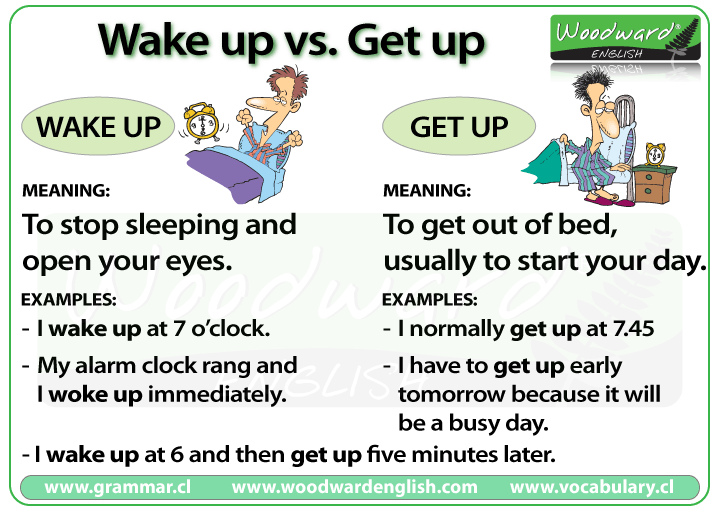
Difference between wake up and get up

Muchas veces confundimos despertarnos (wake up) con levantarnos (get up).
Este listening nos lo aclara un poco más


Click here to listen

The difference between wake up and get up is very small.  But I thought it would be beneficial to know the exact difference.  Wake up is when you wake up from sleep.  Get up is when you get out of bed.  Usually, when people wake up, they get up.  However, sometimes people just stay in bed.  In that situation, they couldn't use these two words interchangeably.  Here is an example dialog showing the difference.

Person A: 'When did you get up this morning?'
Person B: 'I got up at 11.'
Person A: 'You slept at 11 last night.  So you slept for 12 hours?'
Person B: 'No.  I actually woke up at 9, but I just stayed in bed.'

When you talk to people, go ahead and use either of these two words.  Just keep in mind that there is a small difference.

On a side note.  When you ask someone when they woke up, you don't use the past tense of 'woke' although it is referring to the past.  'What time did you woke up this morning' is incorrect.  The correct way to ask this question is, 'What time did you wake up this morning?'

Likewise, you wouldn't say, 'What time did you got up?'  The correct way to say this is, 'What time did you get up?'